
Exploring the Manager Bounce: Our Winning Research at Hudl Performance Insights 2025
We had an incredible experience presenting our work at the 2025 Hudl Performance Insights Conference at Fulham Pier, where our research was selected as one of the winners of Hudl’s annual research competition. The competition attracted a wide range of high-quality submissions, with winning projects presented on the Research Stage at one of the UK’s largest football analytics conferences.
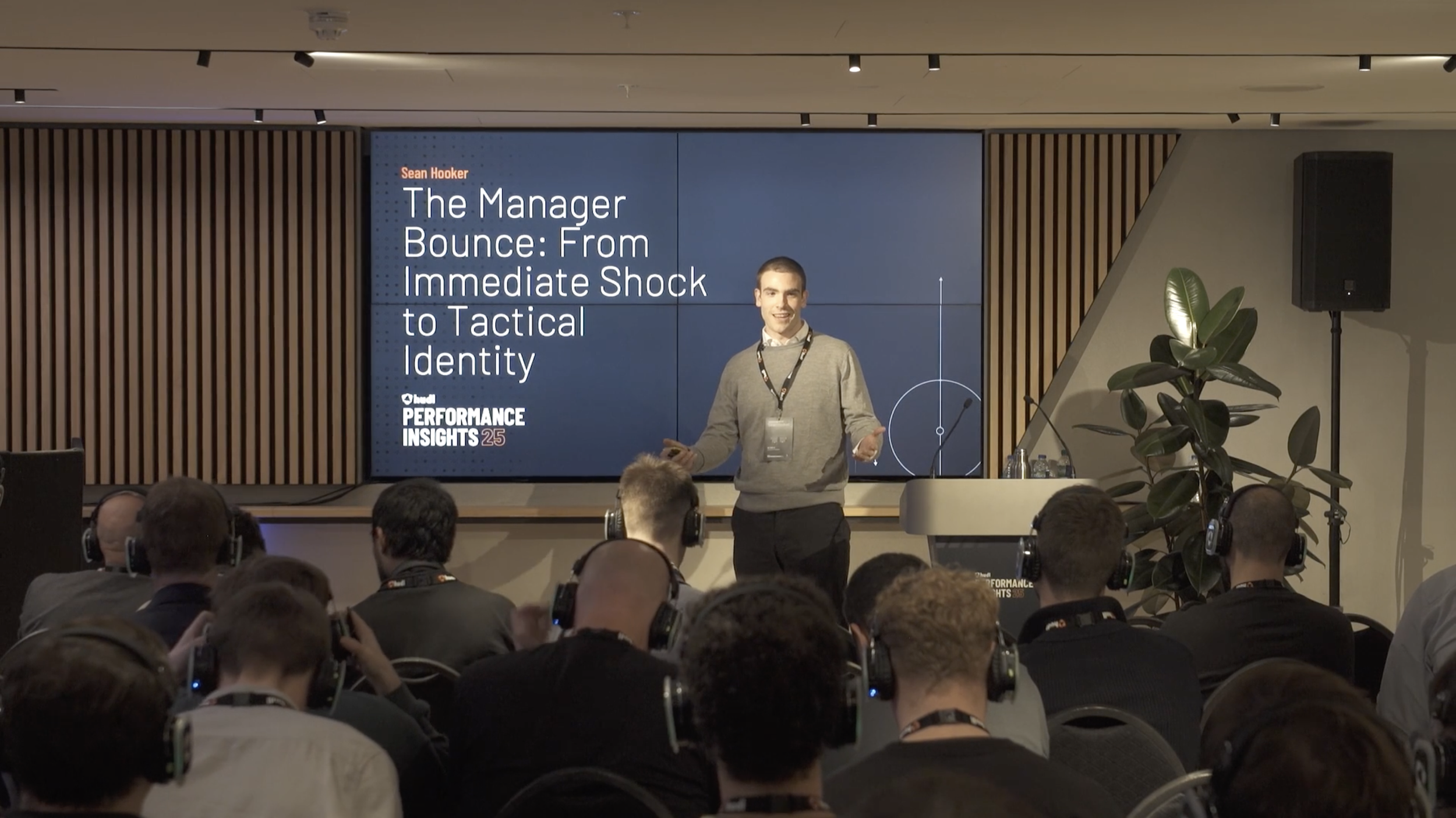
Our paper, The Manager Bounce: From Immediate Shock to Tactical Identity, moves beyond short-term results to explore how a new manager begins to shape a team’s tactical identity from the moment they take charge. While the idea of a ‘manager bounce’ is often discussed in terms of points or performances, our focus is on how style of play evolves, and how quickly a manager’s tactical influence becomes visible on the pitch.
To capture this, we introduce tactical identity vectors—quantitative representations of a team’s playing style derived from coach-driven behaviours such as pressing line height, compactness, directness, and attacking tempo. These vectors act as a tactical fingerprint, allowing us to track how closely a team aligns with a manager’s emerging identity over time.
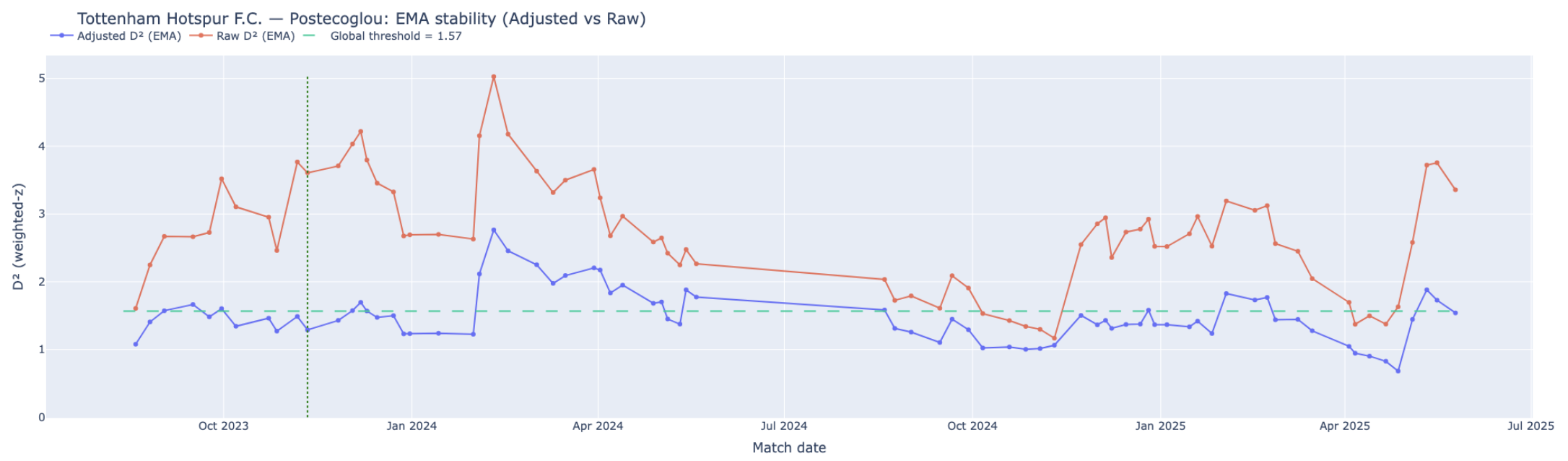
A key contribution of the work is the development of context-aware identity vectors. By controlling for factors such as opposition strength and game state (winning, drawing, or losing), we are able to separate genuine tactical behaviour from external influences. This provides a clearer picture of a manager’s true impact, rather than changes driven by circumstance.
Building on this framework, we apply time-series analysis to identify when a manager’s tactical identity stabilises. This allows us to assess how quickly different managers converge on a consistent style, as well as highlight meaningful deviations from that identity. The approach offers insights that go beyond results-based analysis and has practical value for recruitment, performance analysis, and long-term planning.
If you’re curious about the detailed findings and methodology, you can: